



There are more
placement options
than most families realize.

Most families belive there are only two choices.
General ed.
VS
Special ed.
The truth is there are many placement options
Although Placement options do vary by location we have provided you with the most common model.
Common Misconception
Having an IEP or 504 plan does NOT automatically mean a child is placed in a special ed classroom.
Many students with disabilities spend most—or even all—of their day in general education while receiving accommodations, specialized instruction, or related services.
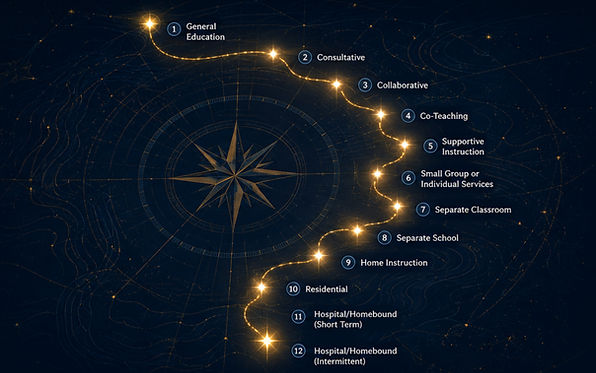
The purpose of the continuum of educational placement options
The purpose of the continuum of educational placement options is
to identify the least restrictive environment (LRE) for each individual student.
Under IDEA, students with disabilities should be educated alongside students without disabilities to the maximum extent appropriate.
The right environment is not simply the least restrictive setting available—it is the setting where the student can access their education and make progress with the appropriate supports, services, and supplementary aids in place. The continuum gives the IEP Team options to consider because placement is not one-size-fits-all. The goal is to determine how the student can be successfully supported in a less restrictive environment before considering a more restrictive placement.
Educational Environment Explorer™
Navigate every placement. Understand every option. Advocate with confidence.


General Education
Consultative
CoTeaching
Collaborative
Supportive Instruction
Small Group
Home Instruction
Separate Classroom
Separate School
Residential
Hospital Short Term
Hospital Intermittent
1. General Education
Instruction provided in the general education classroom with a general education teacher.
WHAT IT MEANS
Your child receives instruction in the general education classroom and participates alongside their peers without disabilities.
supports may be provided through accommodations modifications consultation or other indirect support as needed.
LEAST RESTRICTIVE ENVIRONMENT (LRE)
Schools consider this the least restrictive environment on the continuum.
Who It May Be Best For
-
Students who can access to general curriculum with or without accommodations.
-
Students who benefit from typical peer interactions.
-
Students needing minimal specialized instruction
TYPICAL SETTING

Typically 20 - 30 students.
1 General Education Teacher
QUESTIONS FOR PARENTS TO ASK:
-
What supports have been identified to help my child access and make progress in this classroom?
-
How will the team know whether these supports are working?
Although Placement options do vary by location we have provided you with the most common model.
Does IDEA Outline Placements?
Federal IDEA regulations require every public agency to maintain a continuum that includes:
-
Regular classes
-
Special classes
-
Special schools
-
Home instruction
-
Instruction in hospitals and institutions
-
Supplementary services, such as a resource room or itinerant instruction, alongside regular-class placement
That language appears in 34 C.F.R. § 300.115
The problem is that IDEA does not establish a uniform national menu such as:
General education → co-taught → resource → small-group special education → self-contained → separate school → residential
It also does not define program names like Core, Bridge, SELS, adaptive curriculum, functional skills, or foundations. States and districts create those structures and labels.
That is where districts exploit the flexibility. They may claim:
-
“We don’t have that program at this school.”
-
“Our only self-contained class is for nondiploma students.”
-
“The closest option is co-taught.”
-
“We call that program something different.”
-
“That level of support is only available at another campus.”
Yet the question should remain:
What placement and services does this individual student require to receive FAPE in the least restrictive environment—not what classroom happens to be convenient or already available?
That is exactly why asking for a district’s tangible continuum of placements, program descriptions, admission criteria, diploma track, staffing, class size, and locations is so important. A district saying, “We only have co-taught or a nondiploma self-contained room,” may reveal that it has a continuum problem, not that the student suddenly belongs in co-taught.
What's available in my district?
Now that you've explored the different special education placement options, it's time to take the next step.
🎉 We've made it easy.
Our Continuum of Special Education Placements Request Builder Tool helps you create a professional email requesting your school district's continuum of placements and services. In just a few minutes, you'll have a personalized request that's ready to copy, paste, print, or send.
Knowing what placements and programs your district actually offers can be an important part of understanding your child's options and preparing for future IEP discussions.
What this free tool helps you do:
✅ Create a professional request in minutes
✅ Personalize the email to your situation
✅ Copy, paste, print, or email your finished request
✅ Save time while feeling more confident and prepared
Let's build your request and keep moving forward. 🚀
✉️ Ready to Request Your District's Continuum?

